

 +41 22 880 28 88
 +33 1 41 69 88 88 (Paris)
 +352 26 20 25 53 88

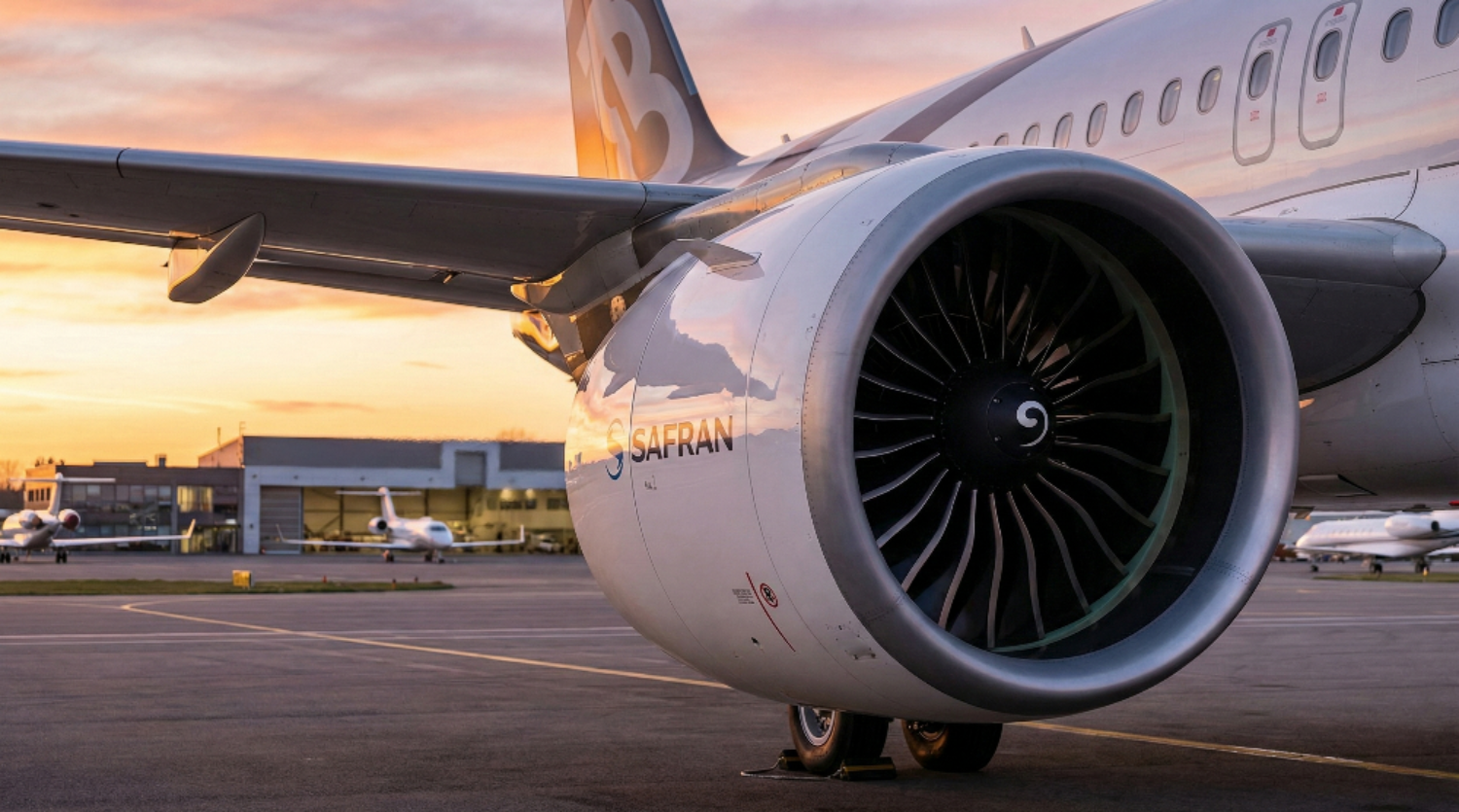
Safran: Understanding the Aerospace Propulsion Giant
Safran is today one of the major players in global aerospace propulsion. Through its subsidiary Safran Aircraft Engines and its joint venture CFM International, the group powers a large portion of aircraft in service worldwide, whether for commercial airlines or the large-capacity private aviation that we operate at
The most iconic engine currently is the CFM LEAP. While often associated with classic airliners, it is above all the beating heart of the most spacious business jets on the market: the ACJ (Airbus Corporate Jets) family and the BBJ (Boeing Business Jets). This engine represents the new generation of high-bypass turbofans. Its principle relies on a large flow of cold air bypassing the hot core of the engine, which strongly improves propulsive efficiency and reduces specific fuel consumption.
Performance and Economy on a Flight Scale
The LEAP offers a fuel consumption reduction of about 15% compared to the previous generation, the famous CFM56 which still equips many older generation private jets. Concretely, this means several hundred kilograms of fuel saved per flight. For a jet owner or during
In terms of performance, the LEAP develops thrust between 20,000 and 35,000 pounds depending on the version. It is designed for aircraft transporting passengers over distances that can exceed 6,000 kilometers. Although it does not have a range of its own—it is the fuel capacity and aerodynamics of the aircraft that determine the ferry range—its efficiency allows for significantly increasing the operational radius. This enables our clients to reach more distant destinations without technical stops.
An Industrial Feat
The manufacturing of these engines is an extremely complex industrial operation. Each engine contains several thousand parts. Safran uses fan blades made of woven carbon fiber composite materials, which allows for obtaining an excellent strength-to-weight ratio.
Certain parts of the hot core are produced by additive manufacturing, that is to say by metallic 3D printing. This technique allows for designing internal geometries optimized for cooling and reducing the number of assembled components. The combustion chambers are designed to improve the air-fuel mixture, thus reducing nitrogen oxide emissions.
The main difference between a modern engine like the LEAP and an older engine, often encountered on the
- A higher bypass ratio, using more cold air for propulsion.
- A higher operating temperature in the engine core thanks to advanced materials.
- Complete digital management via a FADEC system, which permanently controls parameters to optimize performance and safety.
Heritage and Future
Before the LEAP, the CFM56 dominated the market. Produced in more than 30,000 units, it powered entire generations of Boeing Business Jets and Airbus ACJs. Its reliability was exceptional, but its consumption and noise level no longer fully meet current standards. The LEAP improves these aspects while maintaining this high level of operational reliability.
Safran is also working on future generations, notably with the RISE program developed with GE Aerospace, which aims for an additional 20% reduction in consumption within the next decade. In parallel, the group is developing hybrid and electric solutions that could, eventually, transform regional and business aviation.
Safran engines represent today a balance between technical performance, economic efficiency, and environmental transition. They are at the heart of the competitiveness of modern aircraft and constitute one of the major industrial pillars of European aeronautics.